Free Walking Tours In Tokyo (GuruWalk) With Food Stops
A free walking tour is one of the cheapest ways to get oriented in Tokyo, and two English-language walks on GuruWalk, the Tsukiji street food walk and the Asakusa circuit, pass through the city's best eating streets. Here is what each covers, what pay what you want really means, and when a guided tasting tour earns its price.
Short answer
Tokyo has two well-reviewed free English walking tours on GuruWalk: a 1 hour 30 minute Tsukiji street food and culture walk rated 4.91 across 567 reviews, and a 2 hour Asakusa walk rated 4.9 across 667 reviews. Both run on pay what you want, meaning you tip the guide in cash at the end. Neither includes food.
Free walking tours occupy a strange corner of Tokyo travel. They cost nothing up front, they are led by independent guides who work for tips, and the two best-reviewed English walks in the city happen to run through its two most famous eating districts: the Tsukiji Outer Market and the Asakusa temple quarter. For a first-time visitor deciding between a self-guided afternoon and a paid tasting tour, the free walk is a genuinely useful middle option, as long as you understand what "free" means before you show up.
Both walks described below run on GuruWalk, a platform that connects independent guides with travellers on a pay-what-you-want basis. This site does not run these walks and has no affiliation with any of the tour operators listed on this page. That independence is worth stating plainly, because the difference between a free walk and a paid tasting tour is exactly the difference this page exists to explain.
See this free tour on GuruWalk
What Is A Free Walking Tour In Tokyo?
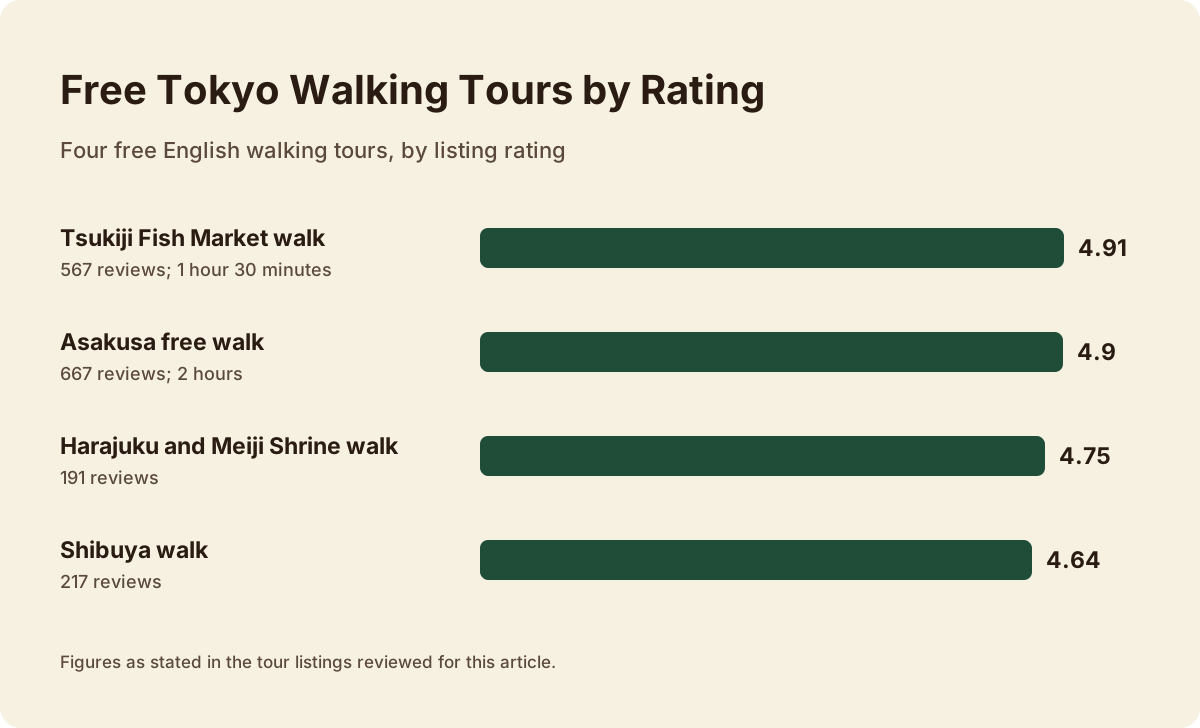
A free walking tour in Tokyo is a guided group walk with no fixed price: you join, the guide leads, and at the end you pay what you think the walk was worth in cash. The two main English options in Tokyo run on GuruWalk, one focused on the Tsukiji market area rated 4.91 across 567 reviews, and one in Asakusa rated 4.9 across 667 reviews. Both last between 1 hour 30 minutes and 2 hours.
The model came out of the backpacking circuit in Europe and spread worldwide. A guide, usually a local who speaks English fluently, leads a group on a set route and earns only what participants hand over at the end. The incentive structure is blunt: a guide who gives a flat, scripted hour gets thin tips, and a guide who answers questions, adjusts pace and points out things you would have walked past gets rewarded. Reviews on both Tokyo walks suggest the guides here take the second path.
Two practical points separate the Tokyo free walks from their European cousins. First, the tip is cash only on at least the Tsukiji walk, so arrive with yen notes, not a card and good intentions. Japan is still a cash-comfortable country at small eateries and market stalls anyway, so this should not surprise anyone who has read about paying in Tokyo. Second, free walks do not include food. The Tsukiji walk is called a street food and culture walk, but food and entries are extra costs the guest pays separately, so factor tastings and any entry fees into your budget.
What Does The GuruWalk Tsukiji Street Food Walk Cover?
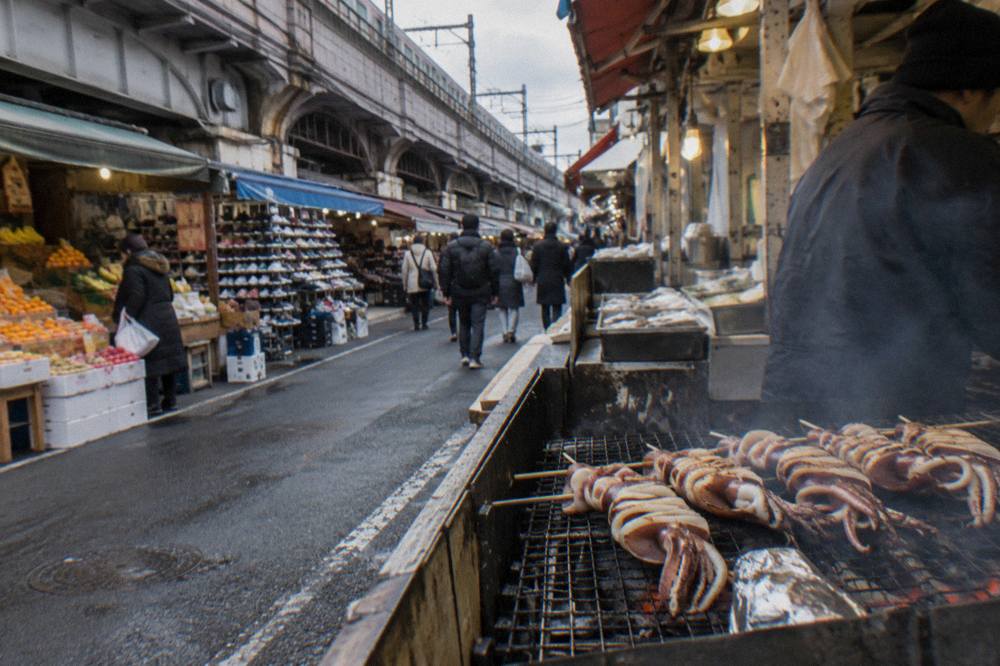
The Tsukiji Fish Market: Street Food and Culture Walking Tour lasts 1 hour and 30 minutes, is rated 4.91 across 567 reviews, runs in English, and meets next to the stairs on the right side of the main hall at Tsukiji Hongan-ji Temple. It is pay what you want, cash only, and food and entries are extra costs the guest pays.
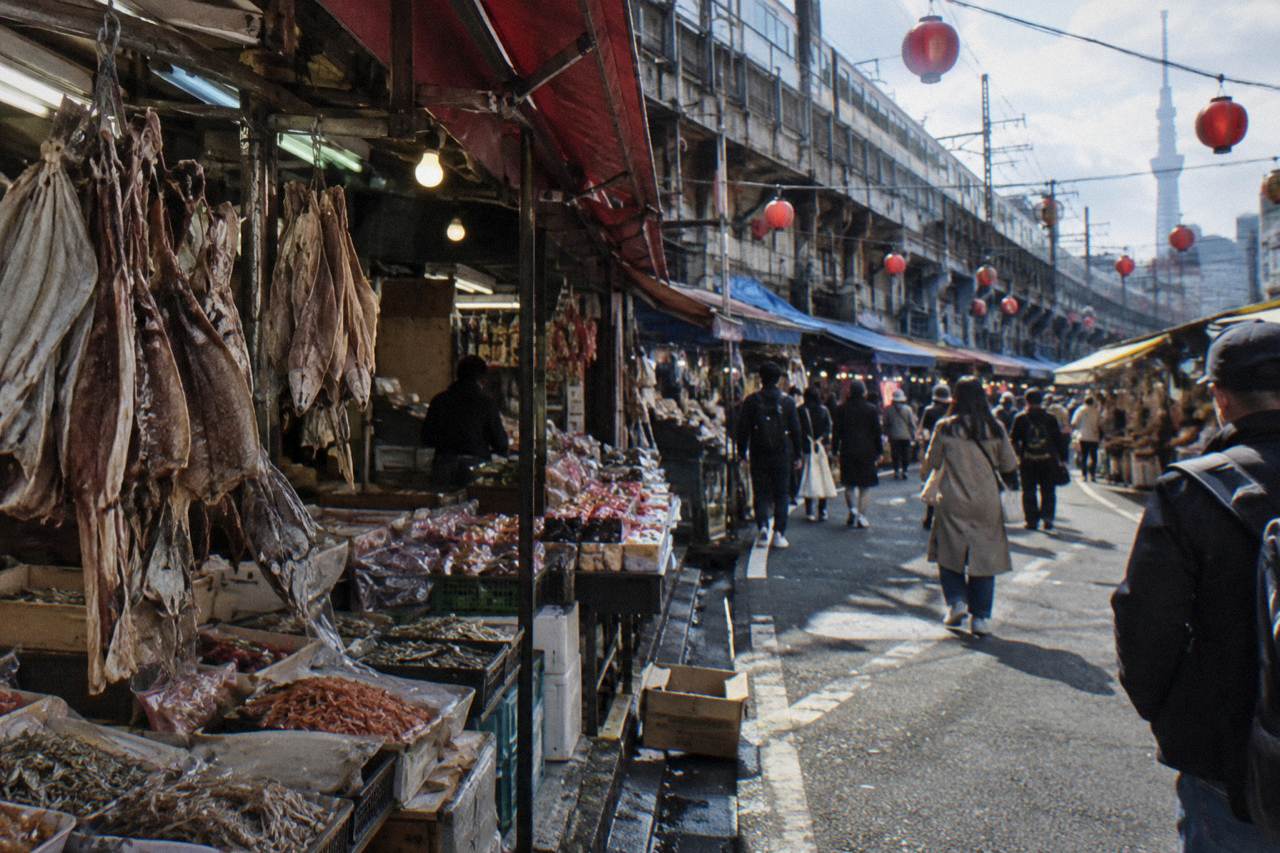
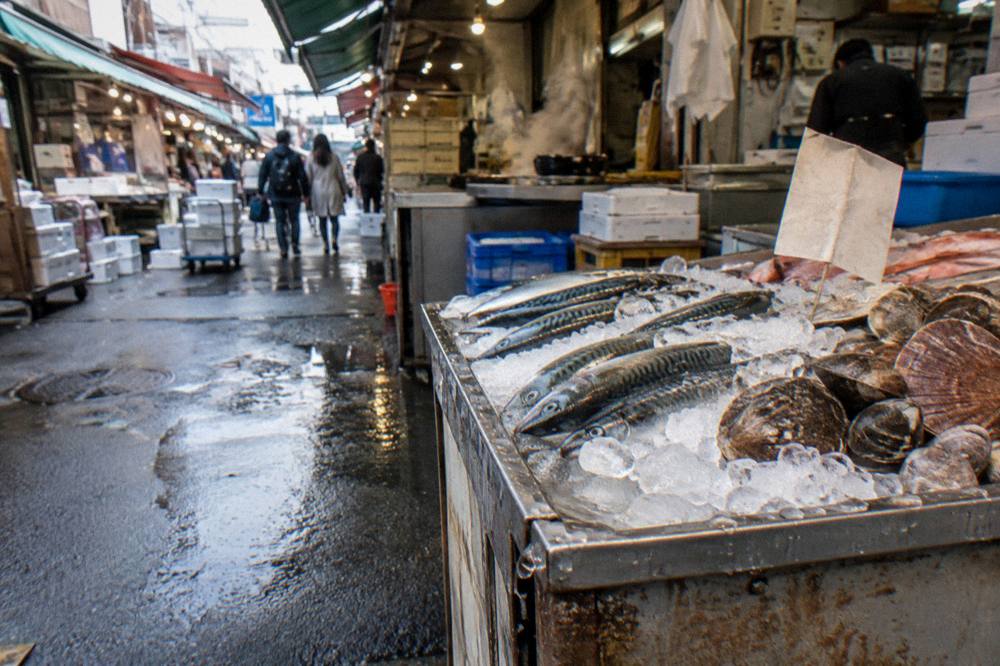
The route works the Outer Market, the visitor-facing strip of hundreds of independent shops selling fresh and processed seafood, dried foods, tamagoyaki, kitchen knives and street snacks. That is a dense 90 minutes. A guide who knows which counters are worth stopping at and which sell to tourists at marked-up prices delivers real value in a place where the sheer number of stalls makes choosing hard.
Hongan-ji is a smart meeting point for another reason: it sits one street west of the market, so the walk starts with a landmark that is impossible to misfind and finishes in the lanes themselves. The Tsukiji walk also carries a practical warning worth internalising early. The official market manners guide asks that eating happen inside the eatery or directly in front of the store, not while walking, and that visitors give way to professional buyers doing actual work. A guide keeps a group inside those rules, which is part of what the tip pays for.
What the walk does not do is feed you. If you arrive hungry expecting tastings, you will buy your own tamagoyaki skewer and your own tuna snack and carry the exact change. For travellers who want the opposite arrangement, food included, route decided, small group, this is where a paid option enters the picture. Among Tokyo Food Tours options is the Tsukiji Fish Market walk: 5 tastings, 3 hours, rated 4.9 across 3,868 reviews, from $97.17 per person. It covers the same district, with the eating built in. We will return to that comparison later in the page.
What Does The GuruWalk Asakusa Free Walk Cover?
The Tokyo Free Walking Tour, Asakusa, is rated 4.9 across 667 reviews, lasts 2 hours, runs in English, and starts at Kaminarimon, the large red lantern gate. It covers Nakamise Shopping Street, Senso-ji Temple, Asakusa Shrine and Hoppy Street, and it is pay what you want at the end.
This is the more traditional sightseeing walk of the two. Nakamise is the approach street to Senso-ji lined with snack and souvenir stalls, some selling the same ningyo-yaki doll cakes and senbei rice crackers that have been sold there for over a century. Senso-ji itself is Tokyo's oldest temple, Asakusa Shrine sits beside it, and Hoppy Street is the short lane of lantern-lit izakaya and stew houses that comes alive in the evening. Two hours is enough to walk all four at a guide's pace with stories attached.
Asakusa rewards a guide more than most districts because the visible sights under-explain themselves. The giant lantern at Kaminarimon has a carved dragon on its base that most visitors never look for. The five-story pagoda next to Senso-ji contains relics rather than being a climbable tower. A guide who fills in these gaps turns a photo stop into an actual visit, and the 667-review track record suggests plenty of walkers felt that happened.
For food-focused travellers, the walk's value is orientation. Asakusa is one of the best-value eating neighborhoods in central Tokyo, and once a guide has shown you the geography, the lanes behind Nakamise and around Hoppy Street are where the more local restaurants sit. If you want that same area covered with a dozen dishes included, an Asakusa guided food tour walks those backstreets with tastings built into the itinerary, which no free walk does. To eat well without spending much, sort The Tokyo Food List by price range and check the Google ratings before you pick a place.
| Walk | Rating | Reviews | Duration | Meeting point | Food included |
|---|---|---|---|---|---|
| Tsukiji Fish Market: Street Food and Culture Walking Tour | 4.91 | 567 | 1 hour 30 minutes | Tsukiji Hongan-ji Temple, by the stairs right of the main hall | No, paid separately |
| Tokyo Free Walking Tour, Asakusa | 4.9 | 667 | 2 hours | Kaminarimon gate | No |
Which Other Free English Walks Exist In Tokyo?
GuruWalk lists other English-language free walks in Tokyo beyond the two headliners: a Shibuya walk rated 4.64 across 217 reviews and a Harajuku and Meiji Shrine walk rated 4.75 across 191 reviews. Both are sightseeing circuits rather than food walks, and neither listing makes claims about food stops.
One line each is all these deserve on a food site. The Shibuya walk covers the crossing, the shopping canyons and the Hachiko statue; the Harajuku walk covers Takeshita Street's crepe stands and the forested grounds of Meiji Shrine. If your trip already includes Tsukiji and Asakusa, these two fill remaining half-days cheaply, and the review pools, while smaller than the two main walks, are large enough to trust the direction of the ratings.
A pattern worth noticing across all four: the free-walk ecosystem in Tokyo clusters around landmarks, not meals. That is not a flaw, it is the format. A guide working for tips cannot buy 10 tastings for a group of strangers, and no honest free tour pretends otherwise. Food on these walks is what you buy yourself, at stalls a guide points out.
How Much Should You Tip On A Pay-What-You-Want Walk?
There is no fixed tip on a pay-what-you-want walk, and GuruWalk does not publish a required amount for either Tokyo route, so the figure is entirely your call. A common approach among walkers is to judge the walk against what a paid tour of the same length costs in the city, then tip at a level you feel reflects the 90 minutes or 2 hours you received.
The honest framing matters here. Pay what you want is a tip to the guide, not a fee for a product. The guide fronts the time, the route knowledge and the answers to your questions, and the payment at the end is your settlement of that. Walkers who tip nothing are, within the rules, allowed to, but the model only keeps producing good guides if the good ones get paid.
Cash logistics deserve one sentence of planning. Arrive with yen notes in small denominations, because the Tsukiji walk is cash only and a guide ending a 90-minute walk does not want to make change for a large bill. Combine that with the general Tokyo reality that smaller shops and ramen counters still prefer or require cash, and a pocket of notes on walking-tour day solves two problems at once.
Tipping elsewhere in Tokyo follows a different rule entirely, and conflating the two confuses travellers. The Japan National Tourism Organization notes it is not common to tip for services in bars, cafes, restaurants, taxis and hotels; staff may even chase you down to return money left on the table. The walking tour tip is the exception you opt into, not the habit you export to dinner.
When Does A Free Walk Not Replace A Food Tour?
A free walk stops being enough when you want food included, a small group, or an evening itinerary, because none of Tokyo's free walks include a single tasting. Paid food tours on this site include their tastings in the price: the Tsukiji market walk includes 5, an Asakusa walk includes 12 dishes, and a Shinjuku walk covers multiple local eateries, roughly 3 hours each.
The clearest case is Tsukiji itself. The free walk shows you the market's lanes in 90 minutes and leaves every purchase to you, in a place where individual snacks add up fast and choosing badly is easy. The paid alternative, the Tsukiji Market walk with 5 tastings, runs about 3 hours from $97.17 per person, rated 4.9 across 3,868 reviews, and folds five tastings plus a guide's market knowledge into one booking. Booking is also where the models diverge practically: a paid tour reserves your spot and can be cancelled per the policy on the booking page, while a free walk depends on showing up and hoping the group is manageable.
The second case is the evening. Every free walk above runs in daylight hours around landmarks, and Tokyo's izakaya culture only makes sense after dark. A Shinjuku izakaya tour or a Tokyo night food tour covers the lantern-lit side of the city that the free format cannot reach, with drinks and dishes included and a guide handling the ordering.
If you are doing the maths, the fair comparison is not "free versus a paid ticket." It is "free walk plus your own market spending" against "one booking that includes the food." At Tsukiji, where the official market site declines to publish fixed street-food prices because they vary by shop, your self-funded snacking total is unpredictable, which is itself an argument for the fixed-price tour when budget certainty matters.
| Feature | GuruWalk free walk (Tsukiji) | Paid Tsukiji tasting walk |
|---|---|---|
| Upfront price | None, pay what you want | From $97.17 per person |
| Rating and reviews | 4.91 across 567 reviews | 4.9 across 3,868 reviews |
| Duration | 1 hour 30 minutes | About 3 hours |
| Food and drink | Not included, paid separately | 5 tastings included |
| Group | Open group, tip-based guide | Guided walk with 5 tastings |
| Payment at the end | Cash tip to the guide | Paid at booking |
How Do You Get To Tsukiji And Asakusa For A Walk?
Tsukiji Outer Market sits a 1-minute walk from Tsukijishijo Station on the Toei Oedo Line or Tsukiji Station on the Tokyo Metro Hibiya Line, per the official market access page. Asakusa is served by the Tokyo Metro Ginza Line among others, and the Kaminarimon meeting point is a short walk from the station exits.
Both walks are therefore reachable with a single IC card and no car. Suica and PASMO cards are mutually usable across JR East lines and Tokyo Metro lines in the Tokyo area, so one tap covers the whole journey either direction. The Yamanote Line connects Shinjuku and Shibuya directly if you are combining a free walk with a stay in the west of the city, and the Ginza Line runs straight to Asakusa from central stops like Ueno and Ginza. If you have not settled on a base for the trip yet, our guide to the best area to stay in Tokyo for food-minded travellers compares these same districts on late-night dining hours, transit links and nightly rates.
Timing around transit matters more at Tsukiji than the map suggests. Retail hoursfor general visitors vary by shop, with professional buyers given priority until 9:00 a.m., and after 14:00 shops operate at their own discretion. Many shops close on Sundays, national holidays and selected Wednesdays aligned with the wholesale market closure calendar. A free walk that finishes at 2 p.m. has, by definition, caught the market at its fullest; one starting late afternoon finds shutters.
What Are The Rules At Tsukiji Outer Market?
Tsukiji's official visitor guide asks that eating happen inside the eatery or in front of the store, not while walking; that professional buyers get priority until 9:00 a.m.; that you ask before photographing, avoid touching food, and leave large luggage in a coin locker; and that smoking happen only in designated areas. Guides must consult the Plat Tsukiji information centre before running tours.
Those rules shape what a guided walk can actually do, and they explain some of the walk's structure. A group that stops, buys, and eats standing at the stall front is compliant; a group grazing on the move is not. The eating rule is the one visitors break most often without thinking, particularly with a fresh tamagoyaki skewer in hand, so treat the guide's pacing around stalls as part of the local choreography rather than dead time.
No bargaining is customary at the market, since items are sold at carefully selected wholesale and retail prices, and the official shopping guidance states this plainly. Plat Tsukiji, the on-site information centre, where strollers can be stored for 500 yen. Strollers can be stored there for 500 yen, useful for families weighing a market walk with small children.
Common Questions About Free Walking Tours In Tokyo
Are Free Walking Tours In Tokyo Really Free?
You pay nothing to join. The walk runs on pay what you want: at the end you hand the guide cash reflecting what you felt the walk was worth. Food, drinks and any entries along the route are extra costs you pay yourself.
How Much Should I Tip On A GuruWalk Tour In Tokyo?
GuruWalk publishes no required amount for either Tokyo walk, so the figure is your decision. Bring cash in small yen notes; the Tsukiji walk is paid in cash only. Many walkers judge the tip against what a paid tour of similar length costs.
Which Free Walking Tour Is Best In Tokyo?
By the numbers, the Tsukiji Fish Market walk is rated 4.91 across 567 reviews and the Asakusa walk is rated 4.9 across 667 reviews. Pick Tsukiji for food culture and Asakusa for temples and old-town atmosphere.
Do Free Walking Tours In Tokyo Include Food?
No. Neither the Tsukiji walk nor the Asakusa walk includes meals or tastings; the listing for the Tsukiji walk states food and entries are extra costs the guest pays. Paid food tours, by contrast, include their tastings in the ticket price.
Where Do The Tokyo Free Walking Tours Meet?
The Tsukiji walk meets next to the stairs on the right side of the main hall at Tsukiji Hongan-ji Temple. The Asakusa walk starts at Kaminarimon, the large red lantern gate, and covers Nakamise Shopping Street, Senso-ji Temple, Asakusa Shrine and Hoppy Street.
When Should I Book A Paid Food Tour Instead?
Book a paid tour when you want tastings included, a guaranteed small group, or an evening route through izakaya lanes, since free walks cover none of those. The Tsukiji Market walk with 5 tastings covers the same market district with food built in, from $97.17 per person, rated 4.9 across 3,868 reviews.
For orientation, the free walks are hard to argue with: two hours, a fluent guide, and a cost you set yourself, in the two districts where Tokyo's food history is most visible. For the meal itself, the paid format still does something the tip-based walk cannot, and choosing between them is mostly a question of whether you want the route explained or the table laid.