Best Ramen In Tokyo: Shops, Queues And Classes
Ramen is the one Tokyo food category where a 900 yen counter bowl can outperform a 5,000 yen dinner, and where the city's own price data, shop customs and a new wave of Michelin recognition all point the same way: the best bowl is usually the one with a queue you can see from the street.
Short answer
The national average price for a bowl of shoyu ramen was 750 yen as of September 2026, and a survey of 81 Tokyo shops found a 600 yen floor and a 993 yen average. Choose by style, buy your ticket at the machine, eat fast, and consider a ramen making class from $75 per person.
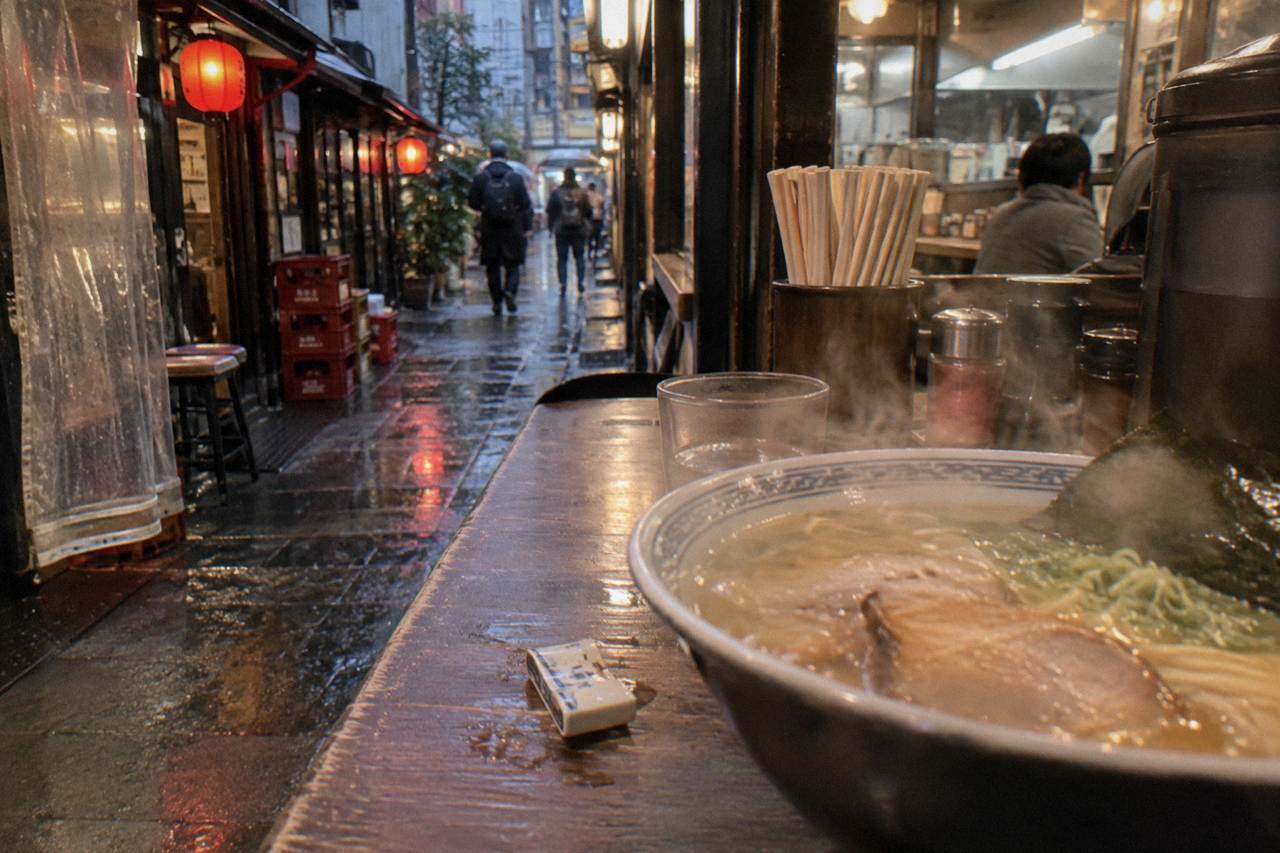
Ramen occupies a strange position in Tokyo's food culture. It is simultaneously the cheapest complete meal in the city and the subject of obsessive, borderline academic pursuit, with shops competing on tare recipes, noodle hydration percentages and broth clarity the way wineries compete on terroir. The Michelin Guide Tokyo 2026 made that respect official by awarding Bib Gourmand status to 16 new restaurants, among them ramen shops including Teuchi Asama and Ginza HARU CHAN Ramen. This guide covers the practical side: what you will pay, which styles to chase first, how the counter customs work, and when a ramen making class is the better use of an evening than a third shop crawl. If your curiosity runs to fish as well as broth, our guide to eating the best sushi in Tokyo applies the same practical lens to counters, conveyor belts and hands-on classes.
For orientation across the city's food neighborhoods, Tokyo Food Tours maintains district guides that pair ramen hunting with izakaya, sushi and market walks.
What Makes A Great Bowl Of Ramen In Tokyo?
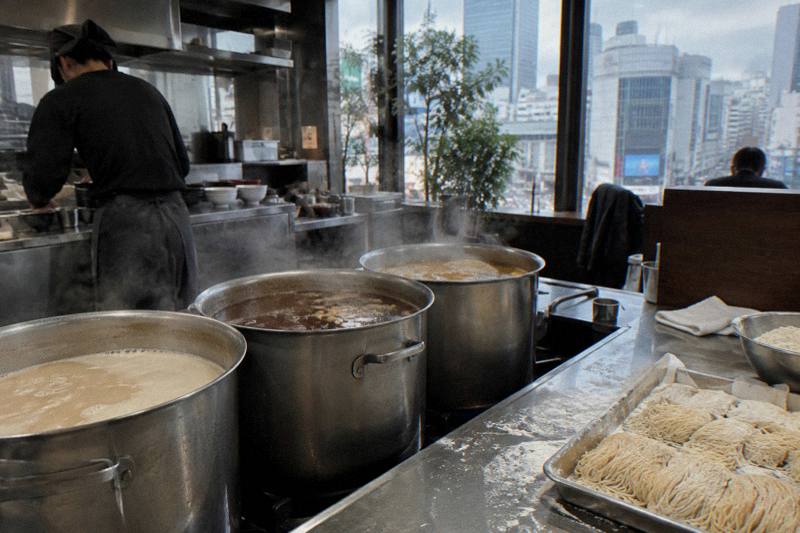
A great Tokyo ramen bowl is judged on five separable parts: the broth, the tare that seasons it, the noodles, the toppings and the finish of fat or aroma oil, and the best shops are the ones that make at least two of those five on site. Broth takes hours, noodles take a day, and a shop that does both will usually tell you so on a signboard or a menu line. Everything else is theatre, pleasant but secondary.
Broth is the engine. Tonkotsu is boiled pork bone until the liquid turns opaque and creamy; chicken paitan follows the same logic with chicken; chintan clear broths are skimmed and clarified, which is harder than it looks and why clear bowls often cost more than cloudy ones. The tare, a concentrated seasoning of salt, shoyu or miso, is what technically defines the bowl's style, so two shops with identical broth can serve radically different ramen.
Noodles matter more than most visitors expect. Thickness, waviness and hydration change how broth clings, and serious shops specify their noodle maker or make noodles in house. The phrase "teuchi" on a signboard means handmade noodles, and it is a reasonable signal of a shop that cares about the carb half of the equation.
Toppings are where personality shows: chashu pork, ajitama marinated egg, menma bamboo, nori, wood-ear mushroom, and regional flourishes like negi abura, a scallion confit. A shop that offers a single topping done exceptionally well, one thick slab of chashu rather than six thin ones, tends to be more consistent than a shop with a twenty-item matrix.
If you want the full anatomy of a bowl explained while you cook it, the Shibuya Ramen Cooking Class covers tonkotsu, shoyu and miso side by side, rated 5 across 259 reviews, from $113.36 per person, and you can check the class details and dates with Ramen Class, Tonkotsu Shoyu Miso on the booking page.
How Much Does A Bowl Of Ramen Cost In Tokyo?
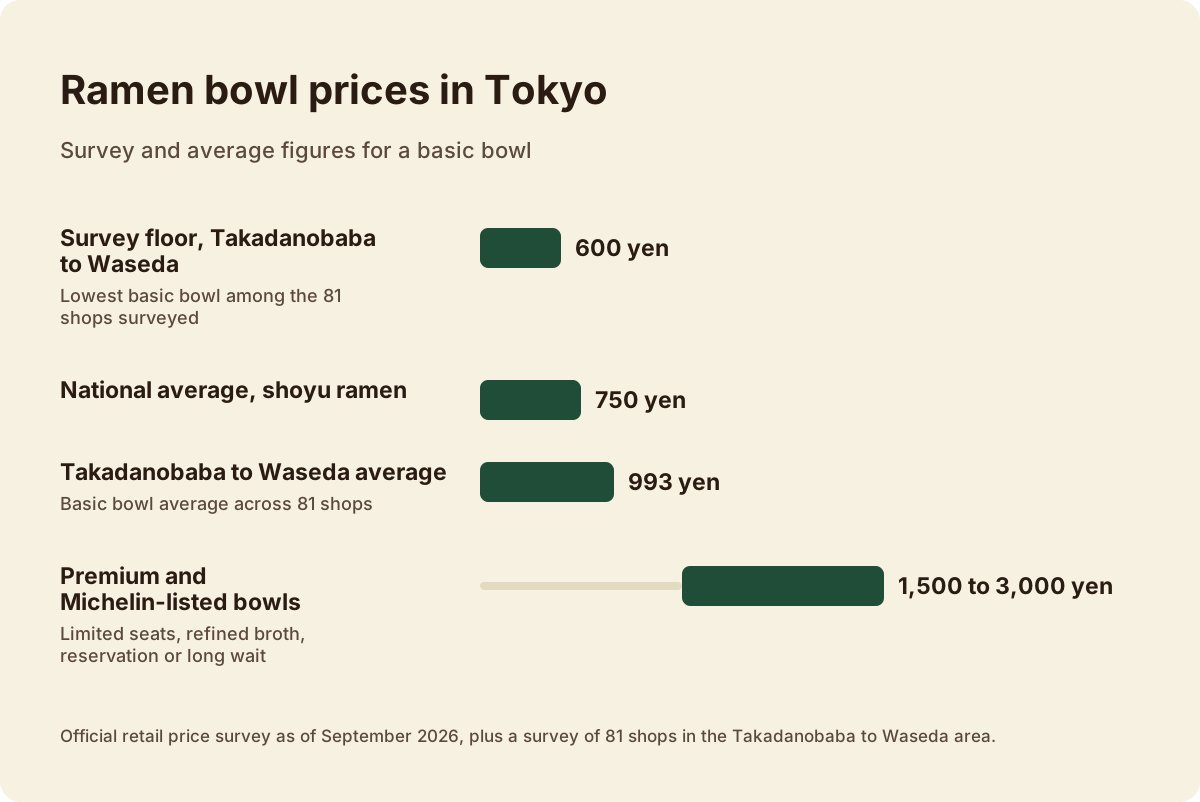
The national average price of a bowl of shoyu ramen was 750 yen as of September 2026, per an official retail price survey, and a survey of 81 shops in the Takadanobaba to Waseda area found an average basic bowl at 993 yen with a 600 yen floor. Premium and Michelin-listed bowls sit at the top of the price range. Budget near the area average and you will eat well almost anywhere.
Those numbers make ramen one of the most price-stable meals in the city, but the spread is real and it maps to ambition. Here is how the tiers typically fall, anchored to the survey data rather than any single shop's promise.
| Tier | Typical bowl price | What you get |
|---|---|---|
| Standing and chain shops | from the 600 yen survey floor | One style, fast service, consistent quality |
| Standard counter shop | around the 993 yen area average | House-made elements, topping choices, a queue |
| Premium and Michelin-listed | 1,500 to 3,000 yen | Limited seats, refined broth, reservation or long wait |
Two cost notes catch visitors out. First, consumption tax: dining in is charged at 10 percent while takeaway food carries the reduced 8 percent rate, per the National Tax Agency, which explains small differences between the menu board and your receipt. A further change is scheduled: for the two years from 1 April 2027 to 31 March 2029 the rate on food and drink sales is due to be lowered, so treat the current split as the rule for now. The agency's own English summary of the consumption tax sets out the two rates.
Second, add-ons. A flavored egg, extra noodles or a beer each add a modest amount at casual counters, with extras priced on the board, so a bowl plus egg plus drink lands noticeably above the base price. None of this needs negotiating: prices are fixed, posted, and paid either at a ticket machine or the register, and no bargaining happens at ramen counters any more than it does at Tsukiji's shops.
For a wider look at eating cheaply across the city, the cheap eats in Tokyo guide covers conveyor sushi, standing bars and convenience store staples alongside ramen.
Which Ramen Styles Should You Try First In Tokyo?
Start with four styles: shoyu, the clear soy-seasoned original that defines old Tokyo; tonkotsu, the rich pork bone broth from Kyushu that now dominates globally; miso, the hearty fermented paste bowls associated with Sapporo; and tsukemen, dipped noodles served broth on the side. Trying one of each gives you the whole spectrum of richness in four bowls, and Tokyo is the only city where all four sit within a few stations of each other. If you're curious how shio fits into the picture, the guide to Japan's main ramen styles explains what sets each broth apart and what a bowl costs in Tokyo.
Shoyu is the local baseline. Old-town Tokyo, the Asakusa and Ueno side of the river, grew up on chicken and dashi broths finished with soy sauce, and the style is lighter, cleaner and more aromatic than its reputation suggests. If your mental image of ramen is a thick white soup, shoyu will recalibrate it.
Tonkotsu is the opposite extreme: pork bone boiled until the collagen emulsifies into something closer to sauce than soup. It is filling, it coats the noodles, and it pairs naturally with thin, straight noodles and strong tare. Miso sits between the two, with paste adding salt, umami and sweetness, and often a scoop of ground pork and corn in the Sapporo manner.
Tsukemen separates noodles and broth entirely. You order cold or warm noodles and a hot, intensely reduced dipping broth, and you dip each mouthful. It suits summer, it suits very rich broths that would overwhelm a soup, and it is the style most likely to convert skeptics who think they do not like ramen. For your next bowl, The Tokyo Food List sorts ramen places by Google rating and price range and says what to order.
The four types each have their own broth logic and topping conventions, and the four types of Japanese ramen explained walks through them bowl by bowl.
A class is one way to taste the styles with commentary; a guided walk is another. The Local Street Food Tour with 10+ tastings at 7 eateries, rated 5 across 42 reviews and priced from $75 per group, moves between seven small local eateries, with ten or more tastings along the way, and it works well as a first-evening orientation before you start choosing your own queues.
Where Do Ramen Lovers Find The Best Shops In Tokyo?
The best hunting grounds are the dense counter districts rather than any single famous shop: Shinjuku's west side around Omoide Yokocho, the Takadanobaba to Waseda corridor with its 81 shop survey, the retro lanes of Sugamo and Ogikubo on the Chuo Line, and the station basements of Tokyo and Ginza. Tokyo ramen culture is organized into rival neighborhoods, each with a claim on a style, and moving between them is half the experience.
Ogikubo is the historic answer. The western suburb built its reputation on old-school shoyu, and ramen historians still treat it as the style's Tokyo home. Sugamo competes on the same nostalgic register with an older, slower crowd. Takadanobaba, by the student corridor toward Waseda, competes on price and volume, which is exactly why its average bowl sits near 993 yen with a 600 yen floor: students keep the market honest. If you want a quick sense of what a bowl should cost elsewhere in the city, the Tokyo ramen price guide lays out survey averages, tax and tipping rules, and neighbourhood ranges.
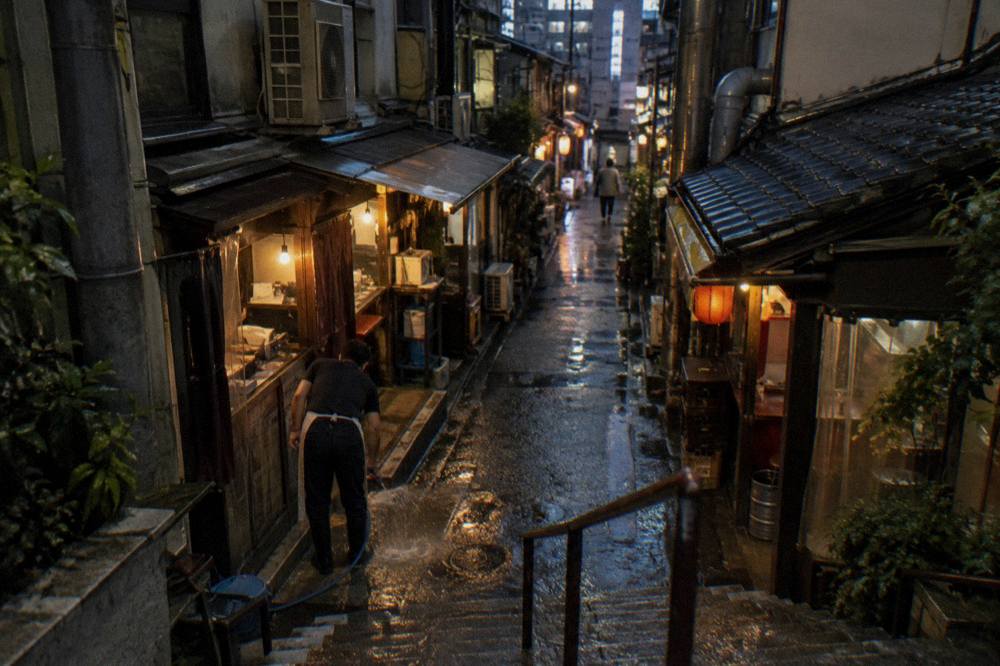
Shinjuku is the highest-energy option. The west-exit lanes hold Omoide Yokocho, a post-war bar district of roughly 80 premises squeezed into about 2,000 square metres, most of them motsuyaki and yakitori counters rather than ramen shops, per the district's official site. Ramen in Shinjuku is more often found on the main streets around the station, where late-night shops serve the after-drink crowd.
Ginza and Tokyo Station counter-program the whole scene with premium bowls. The Michelin recognition of Ginza HARU CHAN Ramen sits in a neighborhood where refined, reservation-worthy ramen coexists with department-store food halls, and the station's Ramen Street gathers regional styles under one roof for anyone who needs to taste five broths without five train rides.
For district-by-district coverage beyond ramen, the Tokyo ramen tour guide and the neighborhood eating guides for Shinjuku and Shibuya map where noodle shops sit inside each area's wider food scene.
How Do Tokyo Ramen Shop Queues And Ordering Work?
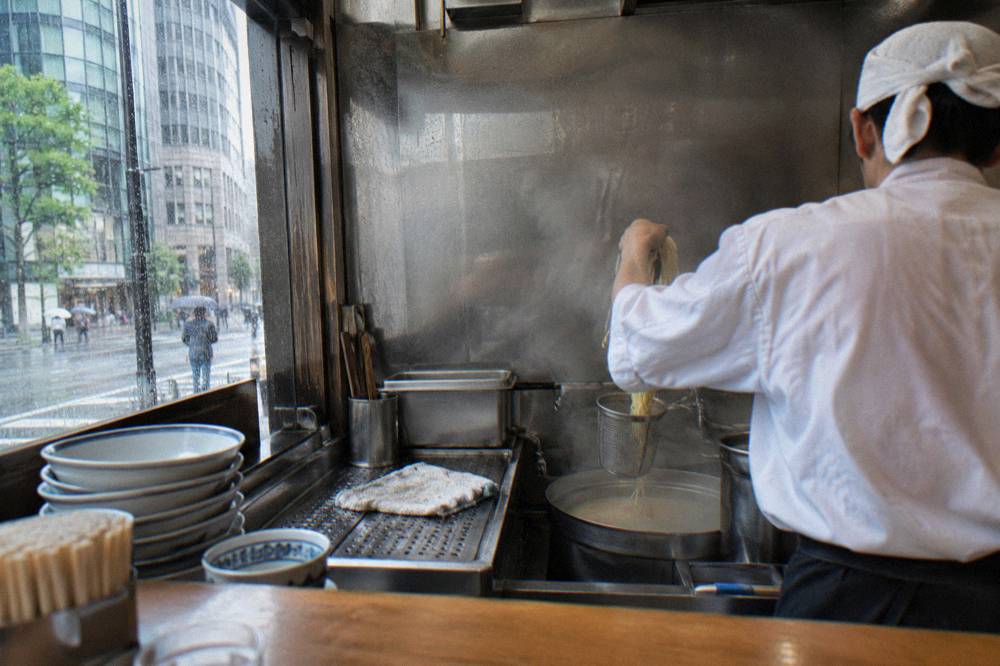
Most Tokyo ramen shops order through a ticket machine beside the entrance: insert cash, press the button for your bowl, hand the ticket to the staff, and sit where directed, often at a counter with fixed seats. Queues are single file outside, the expected eat time is 15 to 20 minutes, and slurping is not just tolerated but functionally normal, since it cools noodles and carries aroma.
The machine removes most language friction because buttons carry pictures, but three conventions still trip visitors up. One: know your firmness preference, katame for firm, futsuu for standard, yawarakame for soft, because staff will ask. Two: cell phone calls and long conversations are discouraged at single-digit-seat counters, where the shop turns tables quickly on purpose. Three: finish what you order, since waste is noticed; the Japanese attitude to unfinished food explains why.
Queueing has its own etiquette. Stand against the wall, do not block the door, and expect the person behind you to stand closer than a Western queue would. Many premium shops use a meal-ticket or numbering system handed out before opening, so if you see a shop assistant outside with a clipboard, that is the line's administration, not a lost tourist.
Payment is cash-friendly territory. Independent ramen shops and small counters often prefer or require cash, though card and cashless acceptance keeps growing in chains and mid-range venues, so carry coins for machines that do not take IC cards. Tipping is not part of the exchange anywhere in the process: the Japan National Tourism Organization notes it is not common to tip in restaurants, bars or taxis, and any cash left on the counter is likely to be chased after you.
| Situation | What to do |
|---|---|
| Ticket machine at the door | Insert cash, press the picture button, give the ticket to staff |
| Staff asks a one-word question | Firmness of noodles; answer katame, futsuu or yawarakame |
| Queue outside | Single file, against the wall, phones on silent |
| Counter with numbered seats | Sit where pointed; do not rearrange |
| Finished eating | Place your bowl on the counter, bow lightly, leave promptly |
Should You Take A Ramen Making Class In Tokyo?
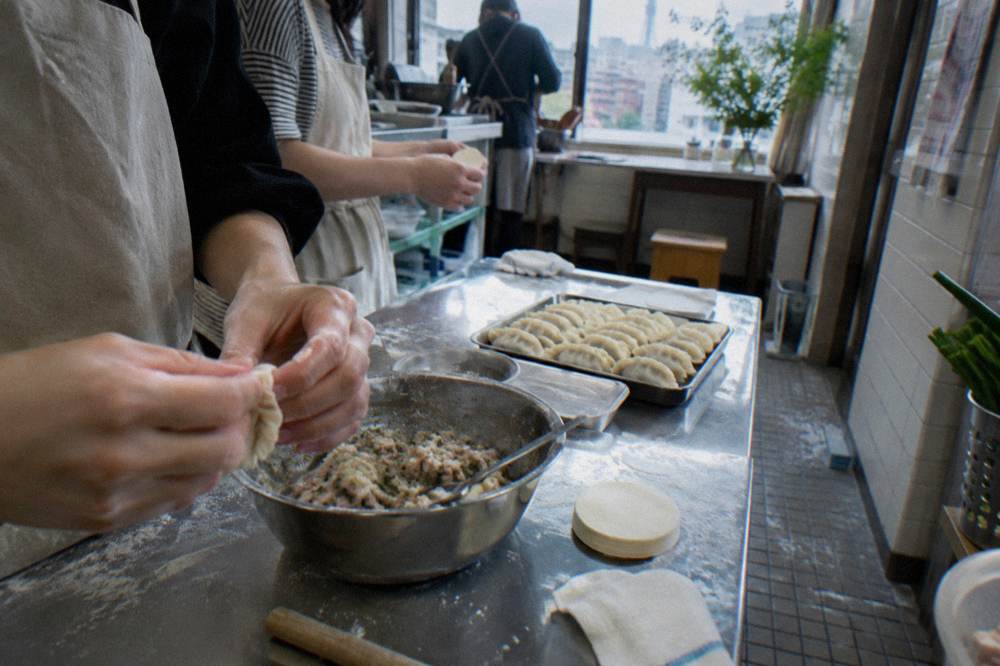
A ramen class is worth it when you want to understand why bowls taste different rather than just eat more of them: sessions run from 1 hour 30 minutes to 3 hours 30 minutes, cost from $75 to $165.19 per person on this site's options, and cover broth, tare, noodles or all three. Classes suit travelers who cook at home, families, and anyone whose trip has more evenings than must-eat shops.
The format differences matter more than the price differences. The Shibuya Ramen Cooking Class, rated 5 across 259 reviews and from $113.36 per person, compresses tonkotsu, shoyu and miso into about 1 hour 30 minutes, which makes it the easiest class to slot into a shopping day. The Ramen Making From Scratch class with an Akihabara tour attached, rated 5 across 143 reviews and from $121.14 per person, spends about 3 hours 30 minutes and adds the neighborhood walk, so it doubles as sightseeing.
The most unusual format is the Become a Ramen Chef for a Day experience, rated 5 across 235 reviews and from $165.19 per person, which puts you inside a working restaurant for about 3 hours 30 minutes rather than a teaching kitchen. That is the one for anyone who has watched a documentary about apprentice ramen cooks and wondered what the counter looks like from the other side.
Dietary needs are better served in classes than in shops. The Small-Group Ramen and Gyoza Cooking with a Tokyo Host class, rated 5 across 73 reviews and from $130 per person, explicitly takes vegan participants, and the fully vegan ramen and gyoza class from $75 per person builds the bowl without animal broth at all, a promise almost no counter shop can make since tare and broth bases are usually pre-built with pork or fish.
What Should You Know Before Eating At A Tokyo Ramen Shop?
Before you sit down, know four things: many small shops take cash only or a ticket machine with cash, smoking is restricted to designated rooms under Tokyo's ordinance and shops must post their policy at the entrance, allergies must be flagged in advance because Japan's allergen labelling law covers packaged food and not restaurant bowls, and no tipping applies anywhere in the meal. Each rule has an official basis, and none is negotiable at the counter.
The allergen point deserves emphasis. Japan's specified allergen list now covers nine items, egg, milk, wheat, shrimp, crab, walnut, peanut, buckwheat and cashew, with cashew added on 1 April 2026, and it governs packaged processed food labelling. Restaurant dishes generally carry no such label, so a ramen shop cannot reliably tell you what is in its pre-made tare. The Consumer Affairs Agency's allergen labelling page sets out the packaged-food duty. If you have a serious allergy, a guided tour where you can message the operator before booking is safer than pointing at a menu board.
Smoking rules are strict and visible. Since 1 April 2020, Tokyo's passive smoking ordinance and the amended Health Promotion Act require restaurants to display whether smoking is allowed, and indoor smoking is confined to designated rooms. Most ramen counters are too small to have one, so expect smoke-free meals at noodle shops even when a neighboring izakaya has a smoking room.
| Rule | Detail | Source |
|---|---|---|
| Cash preference | Small shops and machines often take cash only | Planning range; check the door |
| Tax split | Dine-in 10%, takeaway 8% | National Tax Agency |
| Allergen labels | Nine-item list covers packaged food, not restaurant dishes | Consumer Affairs Agency |
| Smoking | Designated rooms only; policy sign required at entrance | Tokyo ordinance, 2020 |
| Tipping | Not customary at any ramen counter | Japan National Tourism Organization |
One last custom: the otoshi. At izakaya, a small unordered appetizer functions as a per-person seating charge, typically listed on the bill, and it is not a tip or a scam. Ramen counters almost never apply it, but if you move from a noodle shop to a bar afterward and a small dish arrives unasked, that is the charge, and it is legitimate.
How Do You Build A Ramen Day Around A Class Or Tour?
A workable ramen day pairs one shop crawl with one structured session: a morning bowl in a market or station district, an afternoon class where you learn broth and tare, and an evening back in a counter district applying what you learned. With classes from about $71.26 to $165.19 per person and bowls sitting near the 993 yen survey average, a full ramen day costs less than one premium dinner elsewhere in the city.
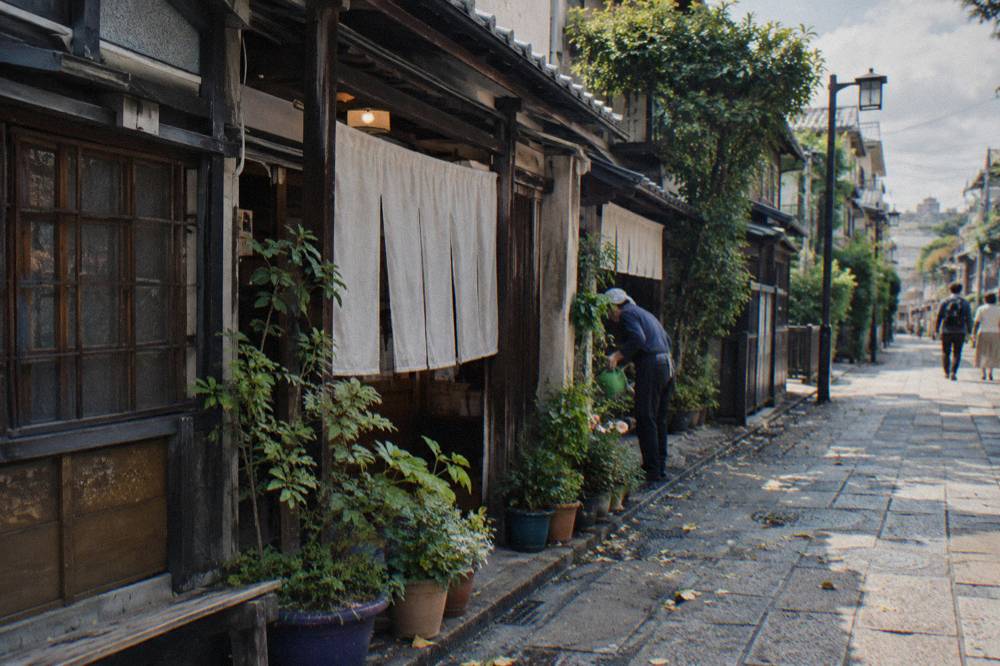
Morning belongs to the old town. Asakusa and Ueno sit on the Ginza Line and Hibiya Line respectively, and both districts lean shoyu, which is the lightest start to a ramen day. A midday class in Shibuya or Akihabara then gives your stomach a rest while your hands work, and the 3 hour 30 minute formats leave you finished in time for the evening shift.
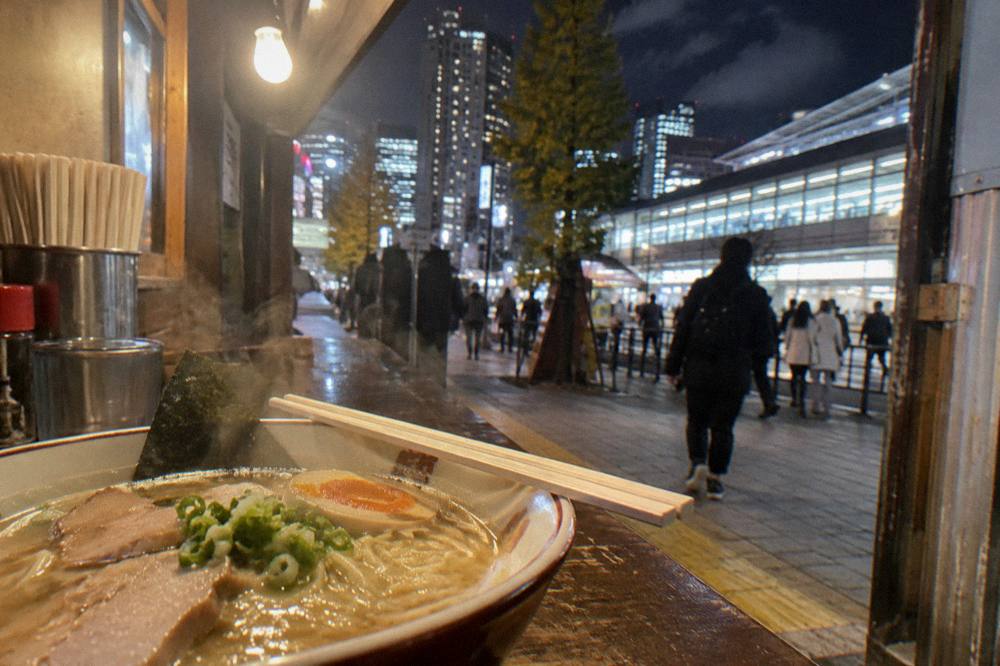
The evening is Shinjuku or Sangenjaya territory, when late shops open and the lanes fill. This is also where a guided walk earns its fee, since a local guide knows which queues move fast and which counters welcome foreigners. The street food walk through seven eateries, from $75 per group, covers this window well, and the district pairing is covered in the where to eat in Shinjuku guide.
Families and mixed groups should weight the day toward the class. A cooking session with children works when a counter crawl does not, kids can press a ticket machine but a two-hour queue cannot compete with rolling noodles by hand, and vegan members of a group are catered for in specific classes as outlined above.
Common Questions About Ramen In Tokyo
How Much Is A Bowl Of Ramen In Tokyo?
A survey of 81 shops near Takadanobaba to Waseda found a 600 yen floor and a 993 yen average, while the national average for a shoyu bowl was 750 yen as of September 2026. Premium and Michelin-listed bowls can reach 2,000 to 3,000 yen.
Which Ramen Style Should A First-Timer Try In Tokyo?
Start with shoyu, the clear, soy-seasoned style Tokyo grew up on, then try tonkotsu for maximum richness. If you have a third bowl in you, tsukemen, noodles with dipping broth served separately, shows a side of ramen most visitors never see.
Do Tokyo Ramen Shops Take Credit Cards?
Many independent shops prefer or require cash, especially ticket machines at the entrance. Chains and mid-range venues increasingly accept cards and cashless payment, so carry coins and small notes as a default.
Is Slurping Ramen Rude In Japan?
No. Slurping noodles is normal and functional: it cools the noodles and carries aroma. What is discouraged is phone calls, loud conversation at tiny counters, and lingering after finishing, since shops turn seats quickly by design.
Can Vegetarians Or Vegans Eat Ramen In Tokyo?
Standard counter ramen is difficult, because tare and broth bases usually contain pork, chicken or fish. Dedicated vegan classes solve this, including a fully vegan ramen and gyoza class from $75 per person and a small-group session from $130 per person that takes vegan participants.
Is A Ramen Making Class Worth The Money?
Classes on this site run from $44.93 to $165.19 per person and last 1 hour 30 minutes to 3 hours 30 minutes. If you cook at home or want to understand why bowls taste different, a class is worth it; if you only want to eat, spend the same money on four more shops.