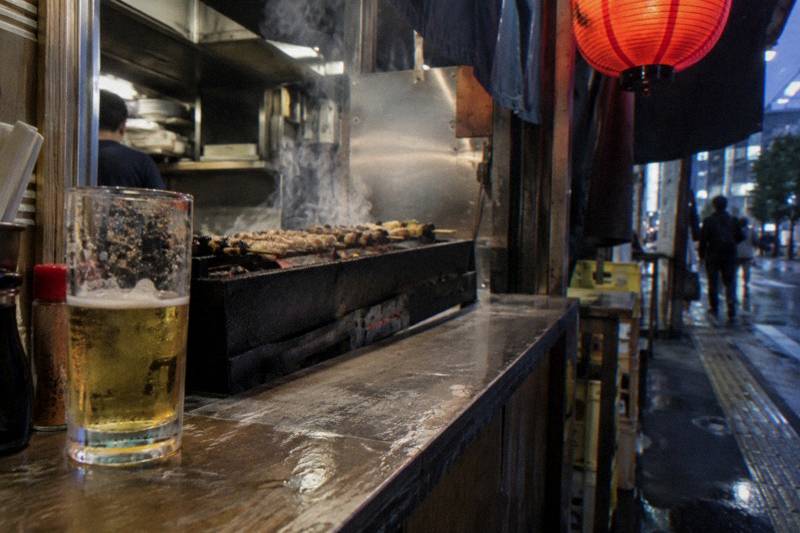
Best Restaurants In Tokyo By Neighborhood
Tokyo has more restaurants than any city on earth, and most of them are average. The trick is knowing which district does what well, what a meal should cost, and how to actually get in.
Short answer
Shinjuku and Shibuya win for izakaya and late-night counters, Asakusa for old-town classics near Senso-ji, Ginza for premium sushi and wagyu. Small-group food walks start from $72.47 per person, and a guided omakase and wagyu walk runs from $130.73 per person.
Tokyo holds the largest concentration of eating places of any city on the planet, spread across districts that each do one thing better than the others. Shinjuku grills. Shibuya stacks thirteen dishes into a single walk. Asakusa preserves the old-town recipes that survived the city's repeated rebuildings. Picking the wrong district for the wrong craving is the most common way visitors end up in a forgettable meal, and it is entirely avoidable.
From Asakusa to Shinjuku, the tours cover the city neighborhood by neighborhood. Each from-price appears on the live booking page, alongside the official visitor guidance Tsukiji publishes. on tax, etiquette and market rules. Along the way it points at the guided options that solve a specific problem, because sometimes the shortest route to a great restaurant is a guide who leads the omakase and wagyu stops in person. The Omakase Sushi and A5 Wagyu premium walk from $130.73 per person is one example of a tour built around exactly that idea. That same logic applies to the city's big-name tables, and the guide to which Tokyo restaurant truly holds the fame crown sorts the contenders while showing how a tour can get you past the booking hurdles they come with.
What Makes A Tokyo Restaurant Worth The Trip?
The restaurants worth crossing the city for are the ones doing one dish for decades, in a room that seats fewer than twelve people, run by the person cooking. Tokyo rewards depth over breadth, so a counter that has grilled the same cut of chicken for generations will usually beat a flashy menu two streets over. That single-dish focus is the organizing logic of the whole dining scene here. Nobody understood that logic better than Anthony Bourdain, and this guide to his Tokyo eating spots shows which of those counters you can still sit at today.
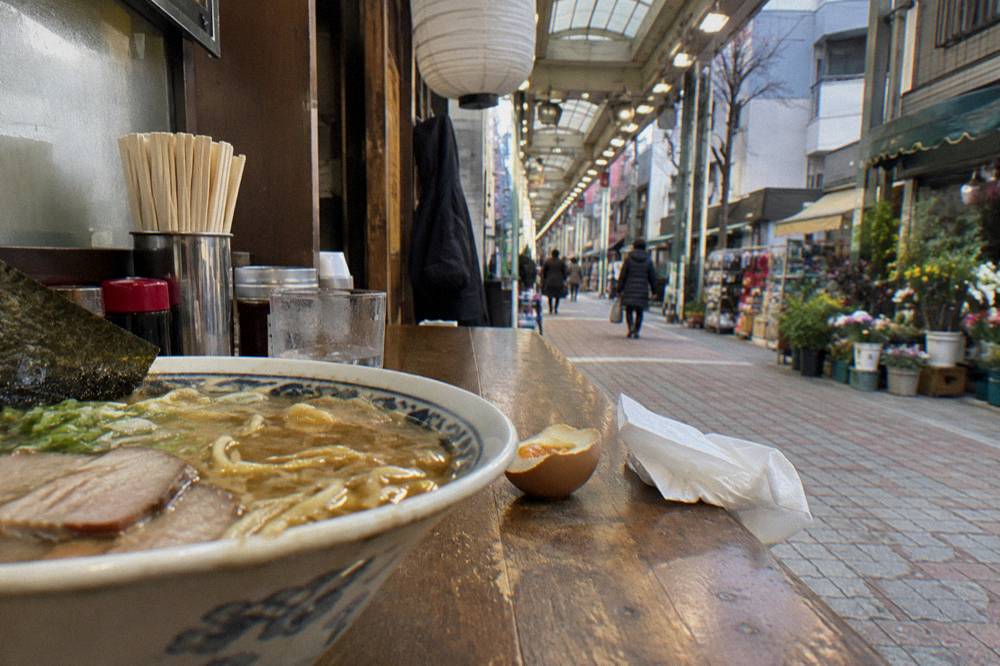
Think in terms of categories rather than cuisines. A yakitori counter specializes in chicken offal and skewers. A ramen-ya does one broth style, maybe two. A sushi counter serves whatever the buyer picked up that morning. The best meals come from matching your craving to the shop type, then the shop type to the district, rather than searching for a restaurant name and hoping. Guest ratings for the eating tours on this site run from 4.5 to 5 stars, and several walks carry thousands of reviews.: the food people remember is nearly always from the smallest, most specialized stop.
Money follows the same logic. The national average for a bowl of shoyu ramen stood at 750 yen as of the September 2026 official retail survey, and a survey of 81 ramen shops in the Takadanobaba-Waseda area put the average basic bowl at 993 yen, with the cheapest at 600. Nigiri sushi averaged 1,592 yen per serving nationally over the same period. Those are the floor figures to measure any restaurant against, and they explain why any bowl priced far above the survey average needs to justify itself.
Transit shapes the decision too. The Yamanote Line connects Shinjuku and Shibuya directly, the Ginza Line reaches Asakusa, and the Hibiya Line stops at Tsukiji for the Outer Market. Suica and PASMO cards work interchangeably across all of these, so no single district is hard to reach from any central base. Choose on food, not geography.
Where Should You Eat In Shinjuku After Dark?
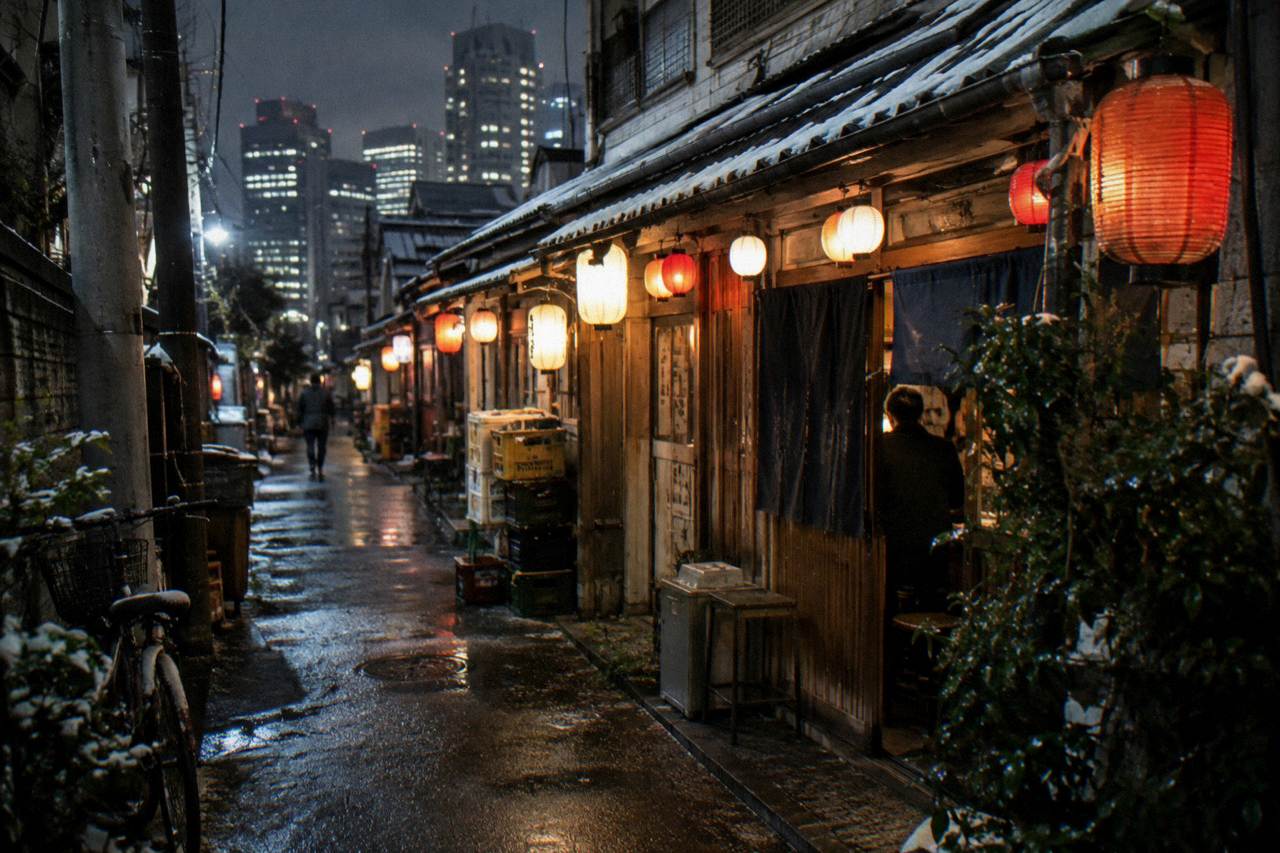
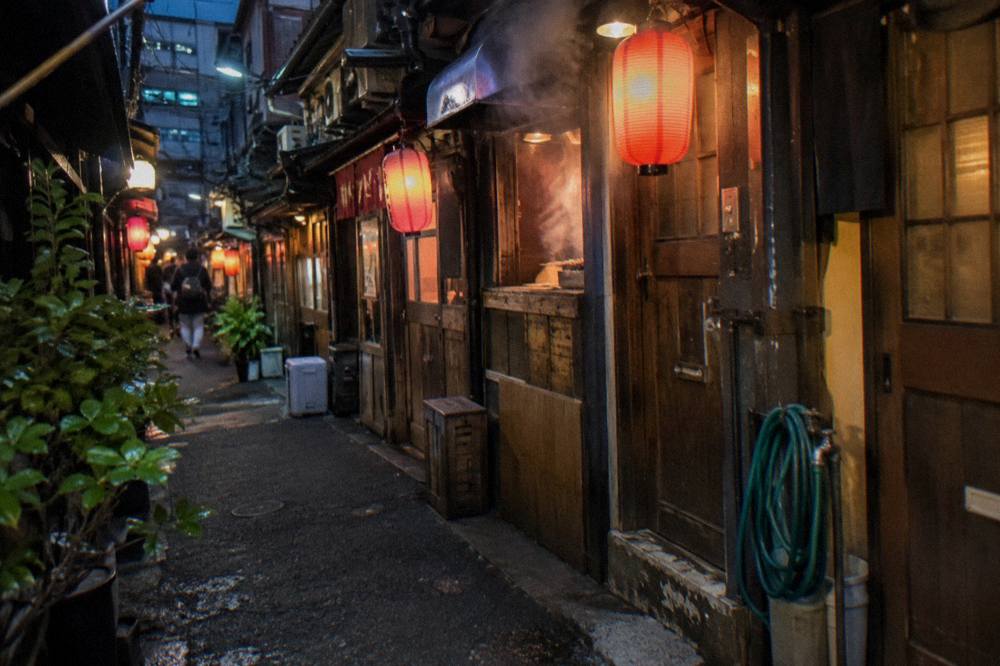
Shinjuku is Tokyo's night-eating capital, anchored by Omoide Yokocho's roughly 60 bars and restaurants packed into about 2,000 square metres near the station's West Exit, plus the Golden Gai bar alleys behind it. Expect yakitori and motsuyaki counters from around 5 p.m., cover charges of 300 to 500 yen at some lanes, and a typical spend of 2,000 to 3,000 yen per person for skewers and drinks.
Omoide Yokocho is the post-war lane that most people picture when they imagine Tokyo at night: smoke, red lanterns, and counters seating six or eight. Its official guide notes that individual shops set their own hours and their own payment rules, and that some add an otoshi seat charge which arrives as a small unordered starter rather than a tip. That otoshi is standard practice across izakaya culture and appears on the bill as a per-person table charge. Our companion piece, where to eat in Shinjuku, goes deeper on individual dish types.
Golden Gai works differently. Bars there typically open around 8 p.m. and close anywhere between 2 and 5 a.m., with cover fees commonly running 500 to 1,500 yen per person, often including a snack. The alleys are private roads maintained by the shopping-street association, and photography on the lanes themselves requires permission, so keep the camera inside the bar and ask first. Many bars welcome visitors with English menus posted at the door, while some remain regulars-only, and cash is still the safe assumption.
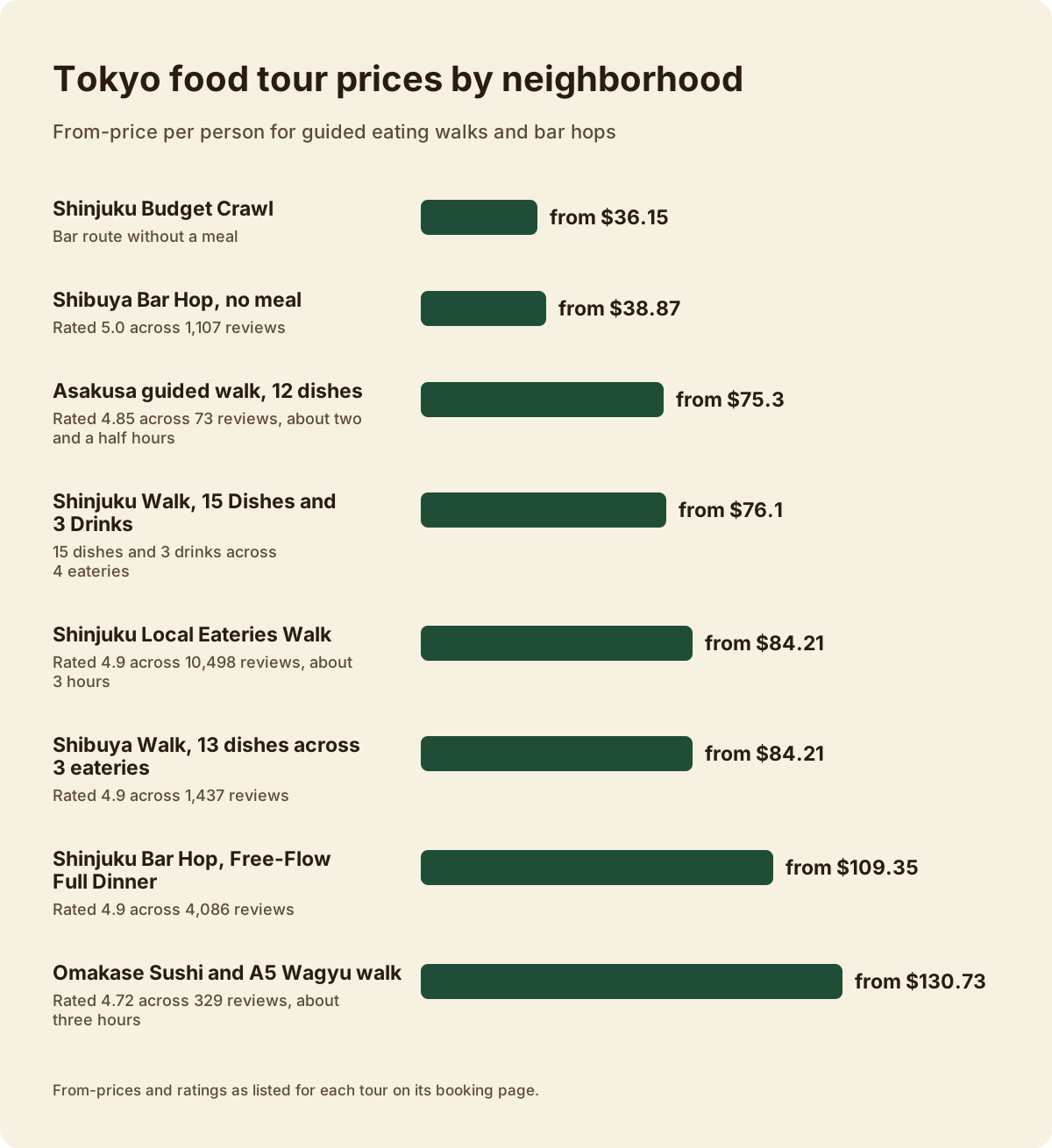
The guided options remove most of that friction. The Shinjuku Local Eateries Walk, from $84.21 per person and rated 4.9 across 10,498 reviews, is the district's most reviewed eating tour, while the Shinjuku Walk with 15 Dishes and 3 Drinks, from $76.1 per person, is the quantity pick. The detailed comparison lives in our Shinjuku food tour guide.
For a full evening with drinks handled, the Bar Hop with Free-Flow Full Dinner through Golden Gai, from $109.35 per person and rated 4.9 across 4,086 reviews, bundles a complete meal with an open-pour drinks window, which solves the cash-only and cover-fee puzzle in one booking. If you would rather pay less and arrange your own drinks, the Budget Crawl at from $36.15 per person covers the bar route without a meal. Either way, bring some yen: the lane's own guidance still lists cash preference at many counters.
| Shinjuku eating option | Typical cost | What it includes | Best for |
|---|---|---|---|
| Omoide Yokocho counter (independent) | 2,000 to 3,000 yen per person, plus otoshi at some shops | Skewers and drinks ordered a la carte | Confident solo diners with cash |
| Golden Gai bar (independent) | Cover of 500 to 1,500 yen, then drinks | One small bar, often a snack with the cover | Bar-hopping after dinner |
| Shinjuku Local Eateries Walk | From $84.21 per person | Guided multi-stop eating walk, about 3 hours | First night in the city |
| Shinjuku Walk, 15 Dishes 4 Eateries | From $76.1 per person | 15 dishes across 4 local eateries | Maximum variety |
| Bar Hop, Free Flow Full Dinner | From $109.35 per person | Full dinner plus free-flow drinks and Golden Gai | A big night out, fully handled |
Which Shibuya Restaurants Serve The Best Local Food?
Shibuya's strength is young, loud, generous eating: standing bars, izakaya chains that locals actually use, and backstreet spots around Sangenjaya and Ebisu. The benchmark guided product here is the 13-dish, 3-eateries walk from $84.21 per person, rated 4.9 across 1,437 reviews, which shows just how much ground a small group can cover in three hours.
The area around Shibuya station has been rebuilt heavily in recent years, and the eating has followed upward: department-store restaurant floors in Shibuya Scramble Square and Miyashita Park sit above older drinking lanes that survive in the gaps. The honest split is that the towers give you reliable, bookable, slightly polished food, while the backstreets give you the grit and the better stories. Sangenjaya, two stations away, is the version of Shibuya where the izakaya still outnumber the cafes, and the Private Sangenjaya Backstreets tour, from $289.25 per person over four hours, is built entirely around those lanes. Eating by neighborhood is easier when The Tokyo Food List shows you what is within a 10-minute walk on a map.
Value hunters have a genuine outlier here. The Shibuya Bar Hop with no meal included runs from just $38.87 per person and carries a 5.0 rating across 1,107 reviews, the strongest review pool at that price among Shibuya's bar-hopping options. It is a drinks-and-atmosphere product rather than dinner, so pair it with a ramen stop afterwards. The full neighborhood breakdown, including family-friendly angles, is in our Shibuya food tour guide.
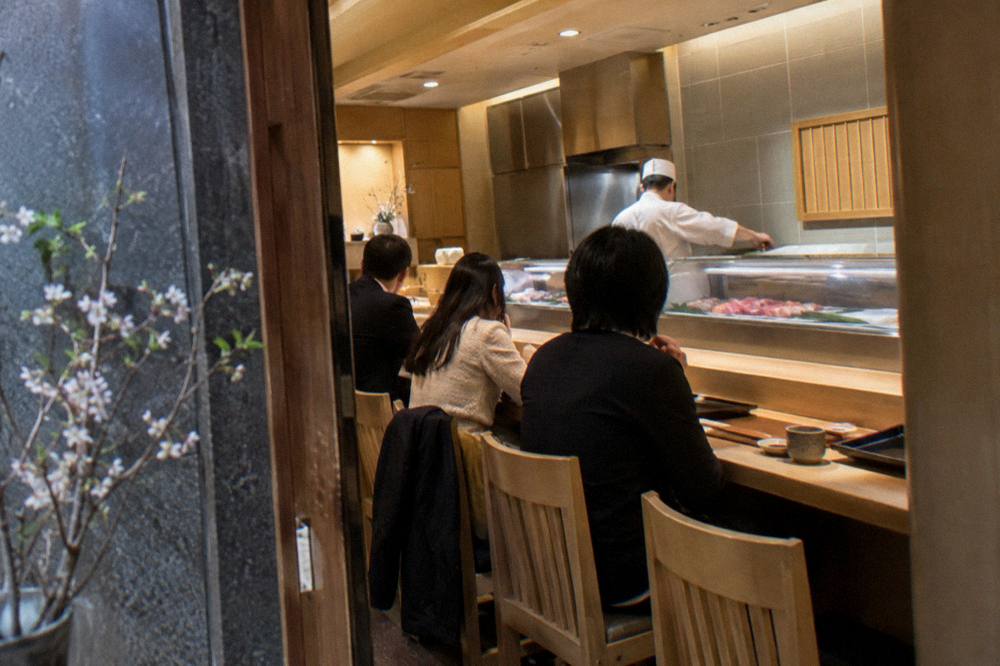
If your real goal in Tokyo is the top-shelf stuff, omakase sushi and A5 wagyu, Shibuya is where that ambition gets expensive fast when arranged independently. The Omakase Sushi and A5 Wagyu premium walk, from $130.73 per person over about three hours, secures both in one guided evening, rated 4.72 across 329 reviews. Compare that against self-arranging a Ginza counter where a single premium omakase seating can exceed the whole tour price before drinks, and the arithmetic of a guided table becomes obvious.
The Shibuya Walk with 13 dishes across 3 eateries, from $84.21 per person and rated 4.9 across 1,437 reviews, doubles as a restaurant reconnaissance mission: every stop is a place you could return to independently the next night, and the guide context tells you what to reorder.
Why Is Asakusa The Best Old-Town Food District?
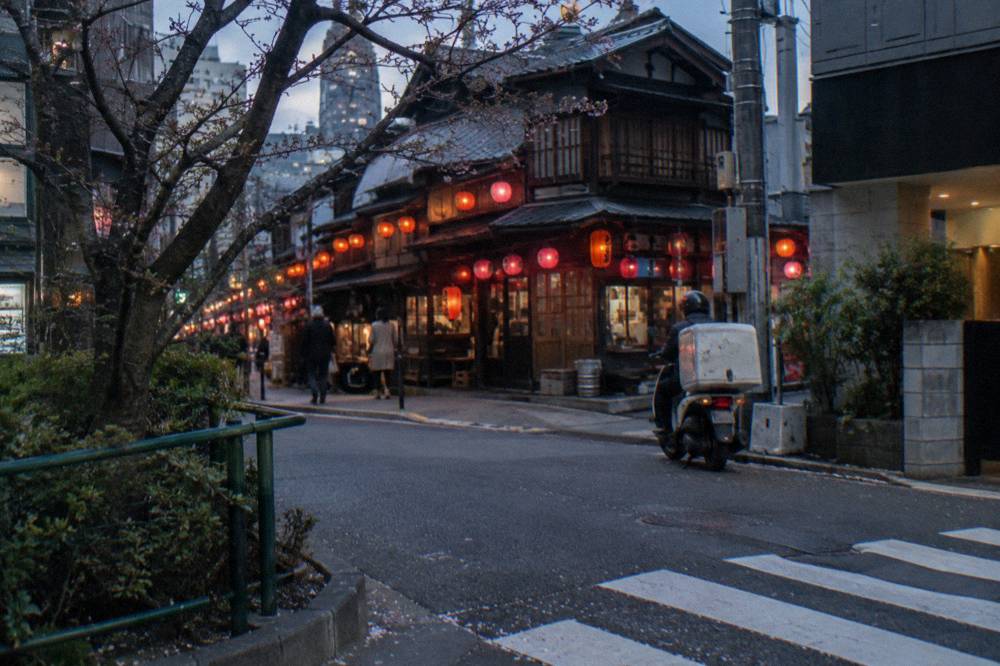
Asakusa concentrates Tokyo's traditional eating around the Nakamise approach to Senso-ji: tempura, monjayaki-adjacent old-town classics, grilled eel, wagashi sweet shops and small counter restaurants, most reachable on foot from Kaminarimon gate. A guided walk here with 12 dishes costs from $75.3 per person, rated 4.85 across 73 reviews, and lasts about two and a half hours.
The district is the city's oldest leisure quarter, and the food reflects that lineage rather than trend. Dishes you find here and nowhere else in quantity include unagi, tempura done in the old Edo style, and the sweets that accompany tea ceremonies. The wagashi tradition is alive enough that a dedicated mochi and nerikiri class operates in the neighborhood at from $80.97 per person, rated 5.0 across 37 reviews. Walking the Nakamise strip is free, and a pay-what-you-want walking tour of Asakusa, covered separately on our free walking tours page, covers the temple geography, though not food.
Tsukiji's Outer Market sits on the Hibiya and Oedo lines and deserves its half-day. The official market guidance asks visitors to eat inside the eatery or directly in front of the store rather than while walking, to give professional buyers priority until 9 a.m., and to skip bargaining entirely since goods are sold at set wholesale-derived prices. Many shops close on Sundays, national holidays and selected Wednesdays that follow the Tokyo Central Wholesale Market calendar, so check the official calendar before committing a morning. The Tsukiji Market walk with 5 tastings, from $97.17 per person and rated 4.9 across 3,868 reviews, handles the etiquette and the queueing for you. The wider set of guides lives on Tokyo Food Tours.
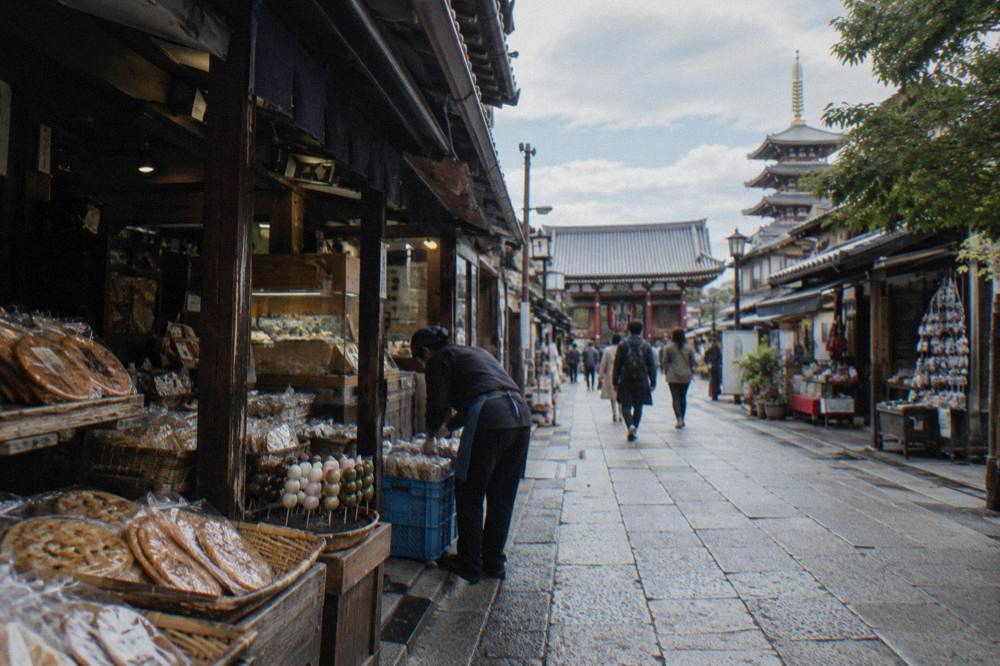
| Old-town district | Signature dishes | Independent budget per person | Guided alternative |
|---|---|---|---|
| Asakusa and Nakamise | Tempura, unagi, wagashi, street snacks | 1,500 to 3,000 yen grazing | Asakusa Walk, 12 Dishes, from $75.3 |
| Tsukiji Outer Market | Tamagoyaki, fresh seafood, knife shopping | 2,000 to 3,000 yen grazing | Tsukiji Market, 5 Tastings, from $97.17 |
| Ueno and Ameyoko | Izakaya food, street skewers, market staples | 1,500 to 3,000 yen | Ueno Walk, 10+ Japanese Classics, from $107.99 |
| Yanaka and east old town | Old-fashioned sweets, croquettes | 1,000 to 2,000 yen | Old Town Premium Walk, from $231 |
Ueno's Ameyoko market street rounds out the old-town set with a rougher, cheaper energy, and the Ueno Walk with 10+ tastings of Japanese classics, from $107.99 per person and rated 5.0 across 349 reviews, is the strongest reviewed product in that corner of the city.
How Much Does A Meal Cost In Tokyo Restaurants?
Realistic per-person budgets run 600 to 1,500 yen for ramen, 1,500 to 3,000 yen at a conveyor sushi chain, from 3,000 yen at a mid-range izakaya with drinks, and well into the premium tier for omakase. Dining in adds 10 percent consumption tax while takeaway is 8 percent, and no tip is expected anywhere in the city.
The floor figures below are ballpark estimates. Yakitori skewers at casual counters commonly cost 150 to 400 yen each, conveyor-belt sushi plates start at 110 to 150 yen, and standing sushi bars near Tsukiji sell individual nigiri from around 90 to 500 yen a piece. Onigiri from convenience stores ran 145 to 149 yen for the basic salt version across the 37 tours in this comparison, which makes them the honest hunger-emergency benchmark rather than a meal. Our cheap eats in Tokyo guide works through the bottom tier in detail.
The tax point matters more than visitors expect. Japan's National Tax Agency applies the reduced 8 percent rate to food and drink excluding alcohol and excluding dining out, so the same sandwich is cheaper carried out than eaten at the counter's tiny ledge. The agency has also announced that the rate on food and drink sales will be lowered for the two years from 1 April 2027 to 31 March 2029, though no new figure belongs in print until it is confirmed. For now, treat 10 percent dine-in as the working number.
Tipping, by contrast, simply is not part of the system. The Japan National Tourism Organization states plainly that tipping is not common for services in bars, cafes, restaurants, taxis and hotels, and staff may chase you down the street to return money left by mistake. The otoshi seating charge you will see at izakaya is not a gratuity but a fixed per-person table charge, typically a few hundred yen, that arrives as a small dish. Upscale venues sometimes add a stated 10 to 15 percent service charge on the bill instead, which is part of the price rather than something extra.
| Meal type | Typical per-person range | Notes |
|---|---|---|
| Convenience store onigiri and snacks | 145 to 400 yen | Tax-inclusive shelf prices |
| Ramen bowl | 600 to 1,500 yen | National average 750 yen for shoyu |
| Conveyor sushi meal | 1,500 to 3,000 yen | Plates from 110 to 150 yen |
| Izakaya dinner with drinks | From 3,000 yen | Plus otoshi at many venues |
| Mid-range guided food tour | $75.30 to $107.99 per person | Multiple stops, food included |
| Premium omakase seating | Well above every other tier | Reservations usually required |
How Do You Book A Tokyo Restaurant Without Speaking Japanese?
Popular Tokyo restaurants increasingly take reservations through hotel concierges, phone, online systems or restaurant booking apps, and high-end venues often require a booking with a card guarantee, with no-shows charged a fee. Casual counters work first-come, first-served, so your strategy is simply to arrive before 7 p.m. or after 9 p.m. to dodge the queue.
Reservation culture here has a specific etiquette worth learning before it costs you money. No-shows and late cancellations can trigger fees at sought-after venues, and notifying the restaurant of any change is considered basic courtesy rather than optional. Many casual eateries take no reservations at all and operate purely on arrival order, while destination spots expect advance booking through a channel they control. If your hotel has a concierge, that desk remains one of the most reliable booking routes in the city for visitors without Japanese, and our Tokyo restaurant reservations guide covers the mechanics step by step.
Allergies deserve advance planning too. Japan's Consumer Affairs Agency mandates allergen labelling on packaged processed food for nine specified raw materials, with cashew nuts added to the list on 1 April 2026, but that duty covers packaged goods and restaurant dishes generally carry no such label, as the agency's own ongoing study of restaurant allergen information makes clear. In practice: tell the venue or tour operator before booking, not at the table. Every guided product on this site can be messaged before purchase about dietary needs, which is one of the quieter arguments for tours over independent research.
Smoking rules affect where you sit rather than whether you can eat. Since 1 April 2020, Tokyo's ordinance and the amended Health Promotion Act require restaurants to post their smoking policy at the entrance, with indoor smoking permitted only in designated rooms. Look for the sticker before you commit to a long dinner, particularly in older izakaya buildings where a smoking room may sit beside the counter.
Do Food Tours Beat Restaurant Research In Tokyo?
For a first visit of three nights or fewer, a food tour outperforms independent research on value, because one guided evening delivers five to fifteen vetted dishes in a single district while a solo diner would need a week of trial, error and translation to assemble the same list. Tours from $36.15 to $145.85 per person cover this range, from bar crawls to tasting walks., with free cancellation on most options.
The honest accounting compares hours. Building a credible personal shortlist for one district takes an evening of reading, cross-checking reviews that may be years stale, and working through reservation systems designed for Japanese speakers. A guided walk costs roughly what one mid-range dinner costs, includes that dinner, and produces a shortlist you can revisit independently. Reviewers describe exactly this outcome across the big review pools: the 4.9 rating from 10,498 reviews on the Shinjuku Local Eateries Walk is the strongest evidence in the city that the format works at scale.
Cooking classes flip the same logic into skills. The Wagyu and 7 Dishes class, from $71.26 per person and rated 5.0 across 202 reviews, and the 3-Hour Sushi Making Class at the same from-price with a 5.0 across 175 reviews, both send you home able to reproduce part of the meal. The ramen classes, from $113.36 for the tonkotsu, shoyu and miso version rated 5.0 across 259 reviews, cost about the same as a handful of restaurant ramen dinners but include the technique. Our Tokyo ramen tour and best sushi in Tokyo pages map the restaurant side of those two foods.
For the premium tier, the Omakase Sushi and A5 Wagyu walk from $130.73 per person, rated 4.72 across 329 reviews, is the clearest single-buy substitute for weeks of fine-dining research, since it combines the two most-requested luxury foods in one booked evening.
| Approach | Upfront cost | Time cost | What you get |
|---|---|---|---|
| Independent research and dining | 1,500 to 3,000 yen per casual meal | Several hours per district | Full freedom, full risk |
| Budget guided crawl | From $36.15 per person | 3 hours | Bars and atmosphere, no meal |
| Mid-range guided walk | $75.30 to $107.99 per person | 2.5 to 3.5 hours | 5 to 15 dishes, local context |
| Premium guided walk | From $130.73 per person | About 3 hours | Omakase sushi and A5 wagyu seating |
| Cooking class | $44.93 to $165.19 per person | 1.5 to 4 hours | A meal plus the recipes |
Whatever mix you choose, book the premium and small-venue pieces early and leave the casual counters to chance, which is the one layer of Tokyo dining where spontaneity still beats planning.
Common Questions About The Best Restaurants In Tokyo
What Makes A Tokyo Restaurant Worth The Trip?
Single-dish specialization run by the person cooking, in a small room. A counter doing one thing for decades will usually beat a broad menu, and that focus is the organizing logic of dining across every district in this guide.
Where Should You Eat In Shinjuku After Dark?
Omoide Yokocho for yakitori and motsuyaki counters, and Golden Gai for tiny bars from around 8 p.m. Expect cover charges of 300 to 500 yen at some counters and 500 to 1,500 yen at Golden Gai bars, and carry cash.
How Much Does A Meal Cost In Tokyo Restaurants?
Roughly 600 to 1,500 yen for ramen, 1,500 to 3,000 yen at conveyor sushi, from 3,000 yen at a mid-range izakaya with drinks, and well above that for premium omakase. Dining in carries 10 percent consumption tax and no tip is expected.
How Do You Book A Tokyo Restaurant Without Speaking Japanese?
Use a hotel concierge, an online booking system or a message through the operator. High-end venues may require a card guarantee, and no-shows can be charged, so always notify the venue if plans change.
Do Food Tours Beat Restaurant Research In Tokyo?
On a short first visit, usually yes. A guided walk from about $75 per person includes the equivalent of a full dinner plus a vetted shortlist you can revisit, replacing several evenings of research and translation.
Is Tipping Expected In Tokyo Restaurants?
No. The Japan National Tourism Organization states tipping is not common for services in bars, cafes, restaurants, taxis and hotels. The otoshi seating charge at izakaya is a fixed table charge, not a gratuity.